Project 04 / 10Robotics · Mechatronics
SCOUT Quadruped Robot
RASTIC · Boston University · Sep 2026 – present
A low-cost quadruped with a 4-DOF camera arm, being built as a search-and-rescue support prototype.
- In active development
- Mechanical
- Embedded
Key result
$500
Parts budget
PlannedA design constraint, not a result: SCOUT is in development and no demonstrations have been run yet.
Technical highlights
- A 12-DOF quadruped with a compact 4-DOF camera arm, planned as a low-cost search-and-rescue support prototype.
- I own the 4-DOF camera arm: its mechanical design, electronics and wiring, and mounting the visible and thermal cameras.
- Right now the leg CAD and the 4-DOF camera-mount design are in progress. Everything else is planned.
- My contribution
- Mechanical design of the 4-DOF camera arm and gripper
- Arm electronics and wiring, and the folding arrangement for walking
- Mounting the visible and thermal imaging system with the software lead
- Tools
- Onshape (CAD)Raspberry Pi 5PCA9685 servo driverROS and simulationInverse kinematics
Overview
SCOUT (Search and Communication Operations Using a Tetrapod) began as an affordable robotic dog for learning how mechanical design, robotics software and AI work together, and is now a proof of concept for search-and-rescue support. I'm building it with two teammates for a RASTIC project at Boston University.
Engineering challenge
After a disaster, debris, stairs and narrow openings make it hard for responders to reach people who are injured. SCOUT is a proof of concept for how a small, low-cost robot could help: a 12-DOF quadruped with a compact 4-DOF arm that can explore a simulated disaster area, help identify a person who may need assistance, report back to an operator, and reach into spaces the body can't fit.
The project started as something simpler, an affordable robotic dog for learning how mechanical design, robotics software and AI fit together, with a parts budget of $500. I'm building it with two teammates: one builds the dog's body and legs, and one leads the AI and software.
Design process
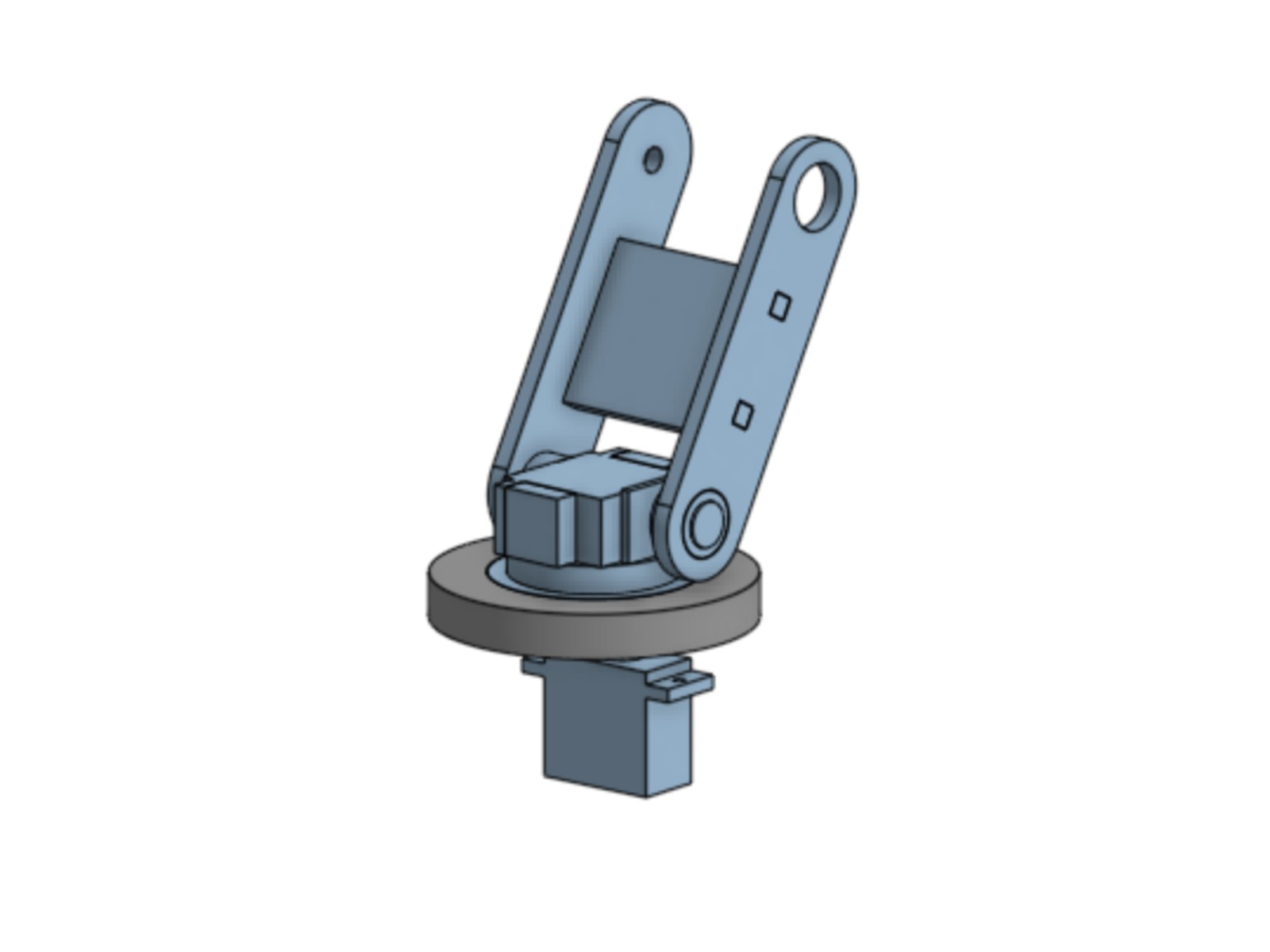
I own the 4-DOF camera arm. That covers the arm and gripper, its electronics and wiring, a compact folding arrangement (folded onto the top of the robot or into the body while it walks), the arm's access to the supply compartment, and mounting the visible and thermal imaging system with the software lead. I'm also exploring a foldable solar-panel mechanism with my mechanical teammate. Right now I'm designing the camera mount in CAD.
The robot has four 3-DOF legs for walking patterns, body-height changes and uneven surfaces. The arm carries a camera and a gripper to inspect narrow spaces and retrieve small supplies. Thermal imaging sits alongside visible imaging because a heat signature alone doesn't confirm that a person is present.
SCOUT is also meant to talk. A microphone and speaker let an operator speak with a person near the robot, over WiFi for demos, with onboard processing and a local link as the longer-term goal. A simple operator GUI lets the operator start a task, view images, receive alerts, check the battery and connection, and stop control.
A supply compartment, holding items such as bandages, sits under a camera that tracks which item the arm removes. Foldable solar panels are being explored as a future option for supplemental charging, to be weighed against their added weight, size and mechanism complexity.
The chassis is a cylindrical concept inspired by the enclosed layout of a submarine, and it is being compared against other layouts for stability, assembly, cooling and repair access.
The planned hardware is a Raspberry Pi 5 (16 GB) as the main onboard computer, and a PCA9685 servo driver for the 16 joints (12 in the legs, 4 in the arm) with a separate servo power supply. An NVMe SSD holds the OS, ROS and sensor data, and an IMU provides orientation and balance. An INMP441 microphone and a MAX98357A amplifier with a speaker handle audio. An Arducam IMX219 USB camera sits on the arm, a TF-Luna LiDAR checks arm clearance, and a NEO-6M GPS is there for future outdoor tests. The control software is planned around an inverse-kinematics gait, ROS and simulation.
The build order is deliberate: test one leg and the arm on their own first (motion, servo loading, wiring and control), then assemble the chassis and four legs, then integrate the arm, cameras, audio and supply compartment, then build the operator interface, and finally run controlled demonstrations.
Build plan
One leg and the arm. Get one 3-DOF leg and the 4-DOF arm working, with servo control, basic voice interaction and camera access.
Chassis and four legs. Build the chassis and four legs, with inverse kinematics and an initial walking gait, body lowering and a folded-arm test.
Integration. Bring the cameras, distance sensing, communication, inventory tracking and operator GUI together, with ROS and simulation.
Demonstrations. Run controlled demonstrations, and record the results and the limitations.
Presentation and next version. Present at RASTIC, evaluate the prototype, and plan the next version, with a focus on reliability, compactness and operation without internet.
Planned demonstrations
The arm reaching through a small maze with the body outside the opening, the robot crawling under a low opening, climbing small stairs, and navigating from point A to point B around obstacles. Inspecting a victim and communicating with a consenting participant or a heated test target. Delivering supplies and tracking the inventory.
Status and impact
In progress now
- CAD of a single 3-DOF leg
- Design of the 4-DOF camera mount (current CAD concept shown above)
Planned, not yet built
- One leg and the arm working, with servo control, basic voice interaction and camera access
- Chassis and four legs, with inverse kinematics and an initial walking gait
- Integration of cameras, distance sensing, communication, inventory tracking and the operator GUI
- Controlled demonstrations, with results and limitations recorded
- Presentation at RASTIC, evaluation and a plan for the next version
SCOUT is in active development. So far, only the leg CAD and the design of the 4-DOF camera mount are in progress. Everything else described on this page is planned, and no demonstrations have been run yet.
The aim is a foundation for affordable tools that university labs, robotics education programs and search-and-rescue teams could evaluate. SCOUT is a prototype and isn't intended for real emergency use.
Gallery